3 WW2 posters
February 10 2026
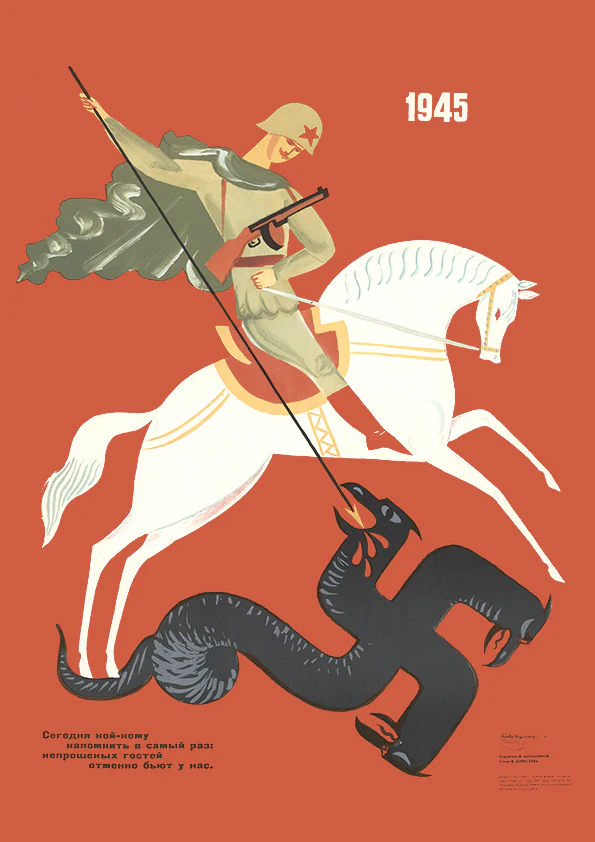
I talked about the folklore-inspired budenovka hat of the red army in my post about Viktor Vasnetsov. a favourite propaganda poster of mine similarly combines Russian revolutionary aesthetics with medieval ones, in which the image of St. George morphs from a Christian appropriation of pagan legend into a communist appropriation of Christian iconography.
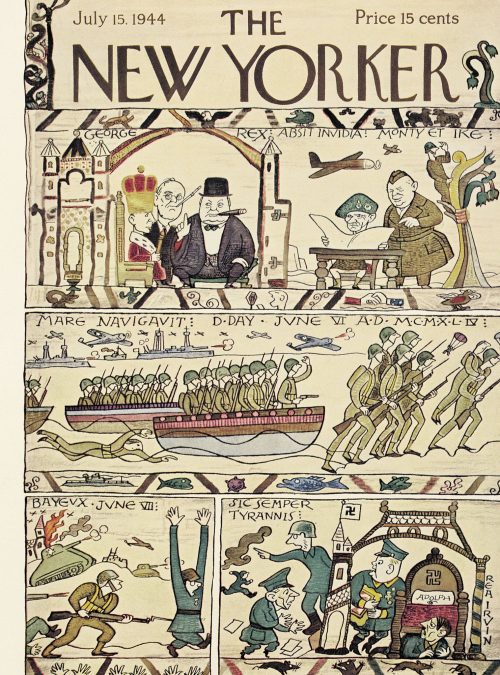
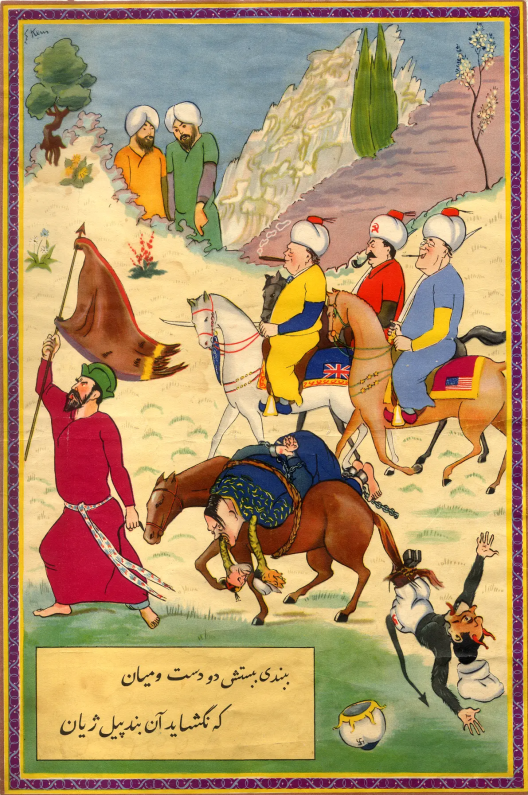
I'm also satisfied by this cover of the New Yorker below that represents the events of D-Day through the Bayeux Tapestry. The conquest of Anglo-Saxon England by the Normans is made the defeat of the Germans by the British, an inversion a little like that of the epic poem Shahnameh that appropriates Alexander the Great’s conquest of Persia by rendering Alexander the Great Persian himself. The poster on the right was commissioned by Britain for an Iranian audience in which Hitler, represented as the Shahnameh villain Zahhak, is captured by Churchill, Roosevelt, and Stalin.
The contradiction of othering is that the aggressor's identity depends on the other, as identity is essentially differentiation. Only when the other is defeated is this relation recognized, so much so that they will be absorbed into the victor's origin mythologies. A return to tradition is only possible when that 'tradition' was once defeated as an exterior enemy and then made interior to the dominant historical chronology. The idealization of the pastoral, for example, reinforces the domination of the urban by rendering it the imaginary origin of the city-dweller rather than their once-transcendent antagonist. this article by metanomad expresses this more colorfully.
I also like what metanomad wrote about the idea of progress. I am becoming less and less convinced not only by returns to a past ideal but conceptions of historical development towards a purpose as well. Almost a year after reading Bataille’s The Accursed Share, I'm starting to understand his economics of excess and waste. I have already written on useless art and I intend to write more on my current embrace of uselessness.