Indieweb carnival: intersecting interests
February 14 2026
I downloaded obsidian only to see my blogs in its graph view.
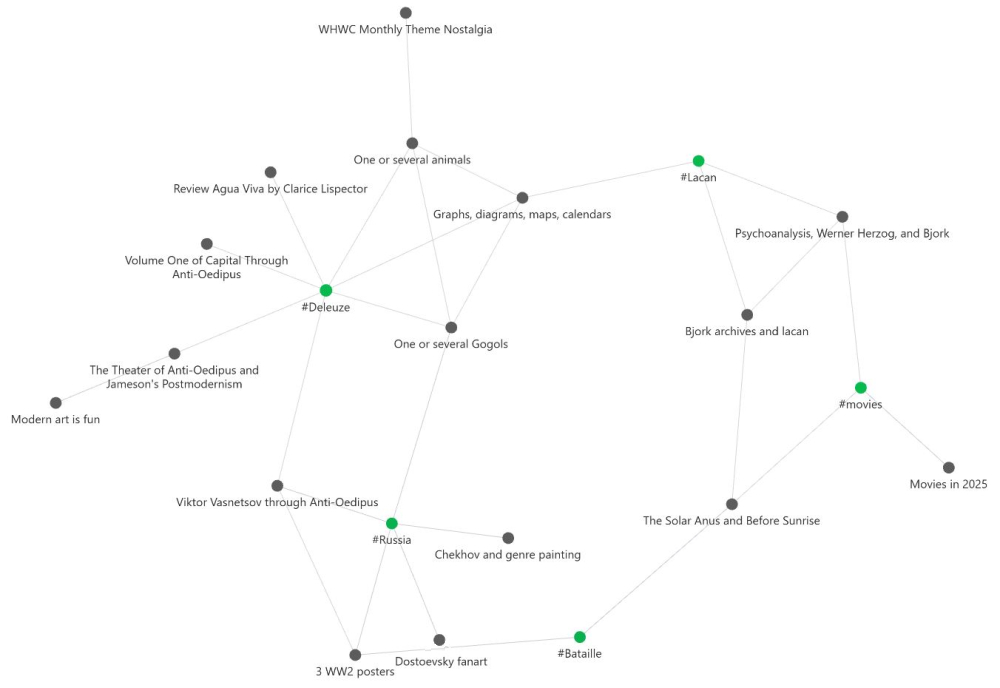
I think what pleases me so much about looking at this graph (and graphs in general) is the creativity of it. Knowledge isn't a large but finite collection of truths to be discovered through a Faustian bargain anymore but something to create by hopping nomadically between different systems of thought or disciplines. Maybe it's unstable and especially uncomfortable to roam so far from sedentary life, but it's playful. This clip from a lecture by Fredric Jameson elaborates on this:
(source)
he explains transcoding to be the difference between the "theory" of the last century and classical philosophy. Instead of different systems competing against each other, these exclusive codes are picked up and dropped like toy blocks, infinitely substituted for the joy of destabilizing them.
I had to read Derrida for a class recently ("Structure, Sign, and Play in the Discourse of the Human Sciences") and what stuck with me was his use of Claud Levi-Strauss' concept of bricolage. the method of the bricoleur is to "conserv[e]" all these old concepts … while here and there denouncing their limits … no longer is any truth value attributed to them; there is a readiness to abandon them, if necessary, should other instruments appear more useful." I wouldn't say "useful," though, because that implies some sort of ultimate end to what Jameson calls theory. I think it's for the fun of "destroy[ing] the old machinery to which they belong and of which they themselves are pieces."
another relevant concept that I came across as a research assistant last summer was translanguaging. I am not confident at all in the field of linguistics but I understood it as an idea competing with that of code switching. instead of a multilingual switching between modes of thought in different languages, they accumulate their own unique selection of linguistic resources called an 'idiolect.' this challenges the conception of languages being at their most pure when spoken fluently, and it demonstrates the changing, unstable quality of language not only at a historical scale but even at the individual scale. Language as a means of creativity as opposed to assimilation. (source)
this blog, "networked thought," influenced my approach to my blog. Jacky writes that the "goal with a digital garden is not purely as an organizing system and information store … I want my digital garden to be a playground for new ways ideas can connect together." they proceed to explain Deleuze and Guattari's concept of the rhizome. as opposed to arborescent (or even phallic) thinking, like that of the evolutionary or family tree, or the root-thinking of cycles, the rhizome is originless, coming and going from a center through an infinite generation of conjunctions.
I think a good bricoleur is an amateur, like discussed on tala's blog; "being an amateur became less about love and more about incompetency. We build entire systems, schools and workplaces, around making sure no one ever looked like one." The sin of incompetency is uselessness. but when we are expected to sell half our lifetimes to work, to usefulness, then we could otherwise transcode, bricole, translanguage, and make rhizomes to waste and destroy, play and have fun.
--
for the february 2026 indieweb carnival, intersecting interests.