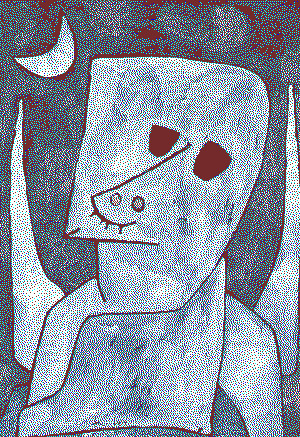
in the same class that inspired this blog for confronting the demand of climate change to be intellectually understandable, we read this article on the "postmigrant condition," on the impulse to meet the other of migration on familiar or understandable terms. this is an assimilationist impulse; any goal towards social unity expects everyone to embrace in a comfortable commonality and to treat otherness as antisocial or a threat. Nielsen rather suggests the less "frictionless" "societies of negotiation." this may already sound abstract enough, but if you couldn't tell what my position is on clarity and concreteness from my hostility to the "understandable" in the first sentence, I want to abstract it even further.
I think interpretation, and metaphors, are responsible for the assimilationism of the intellect. I already wrote about the more obvious Susan Sontag in my blog "political art is not political." it might me useful to repeat my own definition of interpretation from there: "a thing that's hard to understand secretly hides something nicer, neater, truthier behind it." the context was psychoanalytic dream interpretation. Luce Irigaray in the first half of her Speculum of the other woman is also invested in psychoanalysis, in its plight of the un-understandable woman/other, but I actually want to look at her later analysis of Plato's allegory of the cave. she reads the cave as a metaphor for the womb:
"here is an attempt at making metaphor, at trying out detours, which not only is a silent prescription for western metaphysics but also, more explicitly, proclaims (itself as) everything publicly designated as metaphysics, its fulfillment, and its interpretation" (243) 1
the shadow of the platonic ideal is a metaphor, a thing standing for a truthier thing. Irigaray's definition of metaphor: "differences that are measured in terms of sameness" (247). the prisoners of the cave are foreboded by a sameness, that of the pre-oedipal mother or of the real that always returns to the same place, slipping away from the grip of representation. the dream of unity is a return to the womb. this origin allows us to orient ourselves, both relative to a sameness and to a linear progression from a beginning to an end, to a disturbed order that must be restored.
"the cave cannot be explored in the round, walked around, measured in the round. which means that the men all stay there in the same spot--same place, same time--in the same circle, or circus ring, the theatrical arena of that representation." (245)
the theater of Oedipus, another metaphor (or allegory), has served one kind of differentiation relative to a sameness; women and men. the psychoanalyst could trace man's sexed relationship with the world in the stage of his development in which he inherits the law of the incest taboo. it would then be simple enough to reverse the roles of the mother and father to apply the complex to the opposite sex. except, this "dream of symmetry" is frustrated by the girl's incapacity to be castrated by the law; women are closer to nature, to earth, to the divine feminine, they don't know about laws. nonetheless, the metaphor has served us up until now. the psychoanalyst gives up on dispelling her mystique to rather render it inherit to the logic of the metaphor, the confusing thing that's secretly a clear and true thing by detour …
Irigaray looks at the passage between the cave and the ideal. it is the "forgotten vagina:" it is an in between that "is a key passage, even when it is neglected, or even especially when it is neglected, for when the passage is forgotten," it (246):
- links:
- two worlds
- two modes
- two methods
- two measures of:
- replicating
- representing
- viewing
- founds, subtends, sustains, hardens:
- dichotomies
- categorical differences
- clear-cut distinctions
- absolute discontinuities
- irreconcilable representations
the forgotten vagina makes metaphor possible. the symbolic highway saves us the time of those ephemeral, ungraspable transitions, sensations that resist intellectualizing and disturb a clear one and another, allowing for hopping between dichotomies. metanomad explains these dichotomies as belonging to an imperative of progress. whatever doesn't serve the quickest route from A to B is "weird, quirky, needless, silly, a time waste, too much, romantic, sentimental, odd, strange …" in-betweeness is not efficient, productive, or utilitarian, it is only useful when repressed enough to fulfill some ultimate end. and the end of the forgotten vagina -- a forgotten positivity made the negative of lack -- is to represent the phallus, the lack of the phallus that guarantees its desirability and its value.
"this dream of sameness will end up in the fancy--or the inference, or indeed the deduction--that the neck, passage, conduit, that has been obliterated and forgotten, can be nothing but the one, the same, penis. simply "turned inside out, or truncated." (248)
Plato's dialectic -- the dialogue characteristic of his method of philosophy -- is careful. the interlocuters speak one at a time; their conflict is organized and it is comfortable. Irigaray quotes plato on the prisoners in the cave: "while carrying their burdens, some of them, as you would expect, are talking, others silent" (256). if it wasn't for this silence, everyone would talk at once and no single enunciation could be clearly defined by the echo that follows. "sounds would thereby become ill defined, fuzzy, inchoate, indistinct, devoid of figures that can be reflected and reproduced" (257). silence allows for the divisions of the same and the different demanded by the metaphor, otherwise speech would slip away into a perpetual transition and intensity. it would become something of the linguistics of indirect discourse that Deleuze & Guattari suggest over the metaphor.
"… a ban on pulsations, rhythmic intervals that are unlike and yet again the same." (252)
D&G in their plateau "several regime of signs" trace the inheritance of interpretation from the priest to the psychoanalyst. in the 19th century, psychology was faced with the issue of two deliriums, one of imagination and the other of actions. in the former, the patient has all kinds of crazy ideas in their head, but they interact with society just as politely and well-mannered as anyone else (judge Schreber, for example). in the latter, the patient's delirium makes them incapable of good citizenry, often leading to crime. the delirium of imagination is a paranoiac one, that of the priest from whom nothing escapes his infinity of interpretations, whose metaphors of sameness serve the social progression from A to B. the psychoanalyst takes his interpretation further. the aforementioned Platonic silence becomes his tool: "actually, there is no longer even any need to interpret, but that is because the best interpretation, the weightiest and most radical one, is an eminently significant silence. it is well known that although psychoanalysts have ceased to speak, they interpret even more, or better yet, fuel interpretation on the part of the subject, who jumps from one circle of hell to the next. in truth, signifiance and interpretosis are the two diseases of the earth and the skin, in other words, humankind's fundamental neurosis."
"an ideal of truth is in fact necessary to under-lie and legitimize the metaphors, the figures used to represent the role of women, without voice, without presence. the feminine, the maternal are instantly frozen by the 'like,' the 'as if,' of the masculine representation dominated by truth, light, resemblance, identity." (265)
Rae Armantrout in her essay "Feminist poetics and the meaning of clarity" argues for a formally experimental poetry that embraces women's exclusion from the symbolic rather than rehabilitate it with metaphor and narrative ("The one girl at the boys party" by Sharon Olds is a good example of what is opposed here). my professor used the example of Microsoft word's corrections to describe what Armantrout means by "clarity." if you try to write anything on word in your own voice you will inevitably be barraged with corrections for "conciseness;" writing to get from point A to point B.
AI operates with the same logic, too. in the New York Times article "who's a better writer: A.I. or humans?," the reader takes a quiz where they must choose their favourite quote between one that was generated by an LLM and one from an existing work of literature. if you choose mostly "human" writing, the authors write, that, referring to Cormac Mccarthy's unconventional use of punctuation, "ai used to make mistakes like these. but today's systems are much more fluid than their predecessors -- so fluid, in fact, that finding grammatical errors or nonstandard syntax is often a hint that you're looking at a human's prose, not a machine's." if its possible to make mistakes in the use of language, then that implies language serves to represent some sort of truth as accurately as possible. but everyone recognizes now that language is unstable and is constantly changing. yet, we continue to insist on these archaic standards that never really existed at any point of time.
microsoft word and ai's language is deeply phallic. to want a straight path from signifier to signified, metaphor to metaphorized, a rigid relation of representation and thing. a language that conflicts with the grammatical standard -- and this would be really any language spoken in the real world, because these variations exist even at the level of the individual "idiolect" -- rather disturbs the measures of likeness, of a progress relative to the warm womb of sameness that must be reproduced to fulfill a narratological or teleological end.
--