 |
oblomov
(goncharov)
★★★ ½
tried reading it once in high school and then my husband yuri bogatyryov in the movie adaptation convinced me to try it again. tolstoy really distracts from the silliness of russian literature. even dostoevsky was silly, I would say he's the best in the tradition for balancing russian humour and seriousness. here's oblomov being a man-from-underground character:
"no one saw or knew this inner life of oblomov; they all thought that there was nothing special about him, that he just lay about and enjoyed his meals, and that that was all one could expect from him; that it was doubtful whether he was able to form any coherent thoughts in his head. that was what the people who knew him said about him. only stolz knew and could testify as to his abilities and the volcanic work that was going on inside his ardent head and human heart; but stolz was hardly ever in petersburg." (Oblomov)
"Oh, if you only knew what feelings and thoughts I’m capable of, and how developed I am!" (notes from underground)
goncharov is hardly concise, though. I really had a hard time justifying the book's length at the start ("the letter turned out to be long, like all love-letters: lovers are terribly long-winded") but I have to admit that in the end I was much more endeared by the characters than if goncharov turned to conciseness. it's sweet that oblomov is still loved by many people. though it is known as the book in which the protagonist is in bed for the first 50 pages, he's visited by multiple friends through that period (though one of them turned out to be scamming him). definitely more sincere than the gogol I read before oblomov. someone in the comments of the movie's mosfilm upload complained that it was like a soap opera but the sentimentality really honours the book; it's more of a romcom than a satire.
I imagine there would be oblomov/stolz yaoi if oblomov wasn't ugly in the movie. but I have to bootlick heterosexuality because I really did like olga and stolz' relationship in the end. it was satisfying when olga stood up for herself and goncharov's progressive views on marriage we're surprising. I enjoyed her interiority at the end, an interiority interestingly granted when she's free from oblomov. it's almost a reversal of tolstoy's anna karenina (olga) and kitty (agafya) where the happy woman is the one who transgresses the domestic sphere; levin and oblomov confirm an oedipal desire for mothers in decadent aristocrats.
"it never was like a morning which gradually fills with light and colour and then turns, like other people's, into a blazing, hot day, when everything seethes and shimmers in the bright noonday sun, and then gradually grows more paler and more subdued, fading naturally into the evening twilight ... no! [oblomov's] life began by flickering out."
"the fire with which [stolz] lighted the world of knowledge he created for [olga] was never extinguished. he was thrilled with pride and happiness when he noticed a spark of that fire shining in her eyes afterwards, how an echo of a thought he had imparted to her resounded in her speech, how it had entered into her consciousness and understanding, been transformed in her mind and appeared in her words no longer stern and dry but sparkling with womanly grace, and particularly if some fruitful drop from all he had discussed, read, and drawn for her, sank, like a pearl, into the translucent depths of her being."
|
 |
against interpretation and other essays
(sontag)
★★★★ ½
sometimes I feel like I missed out on this time when all the exciting ideas were happening, but I would have had to wait for english translations, I would have had to been studying the classics or something instead, and there was no internet that makes it all so accessible now. here's the blog I wrote on this collection. I started with the "artist as sufferer" essay which was funny because my last engagement with sontag was her reborn journals. this was a very strong start tracing love and literature and suffering from a greek to christian to modern genealogy. please please please forgive me for quoting land but he said one good thing once and I couldn't help thinking of it when reading the next essay on simone weil: "philosophy is a machine which transforms the prospect of thought into excitation: a generator." absolutely the opposite of camus in the next next essay whose philosophy is described as a "domesticated nietzscheanism." she put into words what I don't like about him, his popular nihilism, his image being more attractive than his ideas, and his preachiness.
it was cute to read that she worried claude levi-strauss would lose his relevance (maybe he has in anthropology, but freud remains relevant despite what psychology says about him). sontag's criticism of lukacs' and the frankfurt school's conservative views on art reminded me of my viktor vasnetsov criticism; I always preferred the psychoanalytic than the marxist approaches to literature because they can be more formal. calling sartre's book on jean genet "cancer" in the first line was a little funny because the first time I heard of sontag was in first year when we read an excerpt of her "illness as metaphor." the directionless ranting in "going to theatre, etc" essay was a nice break. she was here more of a literary critic than a literary theorist. I could not follow what she was saying about james baldwin's play, though, but I don't think its worth reading what she has to say about it. the essays on movies were fun because I had actually watched many of them; loved the analysis of vivre sa vie as a culmination of her anti-psychology.
what was annoying was sontag's anti-communism that always holds back the american intellectual. I could not take seriously that her criticism of camus stopped only to praise him being soo brave to stand up against the french communists. it's impressive how closely she followed the academic trends in europe, but she ultimately doesn't get away from her americanism, though she's self-aware that the us intellectuals were really falling behind. she almost feels in this collection like a reporter of the ideas going on in europe than anything. but I assume it was the best she could do despite cold war censorship. the "happenings" in new york sounded fun, though. and it was endearing to read her afterword in which she was forced to read her old work from 30 years ago.
|
 |
les armoires vides
(ernaux)
★★★★ ½
[read for class] [read in french] took my time with this one because I wanted to like it, and I did. it's the sort of resentful interiority I like to read of women that's not the melodramatic navel-gazing of la vagabonde.
"brusquement riche de mille points sur mon corps et je sais qu'ils ne sont pas tous découverts."
"mais saisit érotiquement la peau comme une multiplicité de pores, de petits points, de petites cicatrices ou de petits trous, saisir érotiquement la chaussette comme une multiplicité de mailles, voila ce qui ne viendrait pas à l'idée de névrosé, tandis que le psychotique en est capable." (mille plateaux)
"que je sois ta plage et tes tissus, que tu sois mes orifices et mes paumes et mes membranes, perdons-nous, laissons le pouvoir et la justification immonde par la dialectique du rachat, soyons morts." (économie libidinale)
|
 |
zeros + ones : digital women + the new technoculture
(plant)
★★★★
I was curious about the woman that wikipedia attributes as a leader of the ccru. her book excited me enough to post 3 blogs about it, this one and this one and this one. despite my misandrist tendencies, I have avoided engaging any deeper with feminist theory for the exact reasons in that famous dworkin quote: "many women, I think, resist feminism because it is an agony to be fully conscious of the brutal misogyny which permeates culture, society, and all personal relationships." I tried to read Irigaray last summer but some part of me felt that it wasn't the time for that yet. what might make now the right time is that all three literature courses I am taking this semester have assigned about half or more women writers, though none at all are particularly obligated to do so by the course's subject (i.e. they are not on "women's literature"). my experience so far in my english major had made the minority representation of women writers appear like a fact of life. another likely factor is that for more than half a year now I've been experiencing my first romantic relationship with a man. now, all the irigaray citations in zeros + ones have made me very excited to revisit her. It's also the optimistic tone of sadie plant's writing that made this book an easy first step into my new reading project. very accessible writing, too (this was the first time that the term cybernetics meant anything to me).
besides what I talked about in the above blogs, a chapter that really stuck with me was "runaway." it articulated what is hard to defend about the 60's sexual revolution. I want to read more about what plant says that foucault said about desexualizing pleasure, and what lyotard said about, well, let me repeat the quote: "'use me' is a statement of vertiginous simplicity, it is not mystical, but materialist. let me be your surface and your tissues, you may be my orifices and my palms and my membranes, we could lose ourselves, leave the power and the squalid justification of the dialectic of redemption, we will be dead. and not: let me die by your hand, as Masoch said."
|
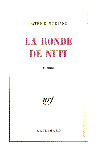 |
la ronde de nuit
(modiano)
★★ ½
[read for class] [read in french] the trade-off for the easier vocabulary of 20th century french novels is that I can't tell if it's nonesense because my french is bad or because it's intended to be experimental like that. it's like I grasp actions in their individual parts but I struggle to put together the whole. the first 60 pages felt like muriel spark's not to disturb; lots of absurd characters that don't compel me enough to try to understand them, some that are called barons and baronesses, none of which are concerned about screams in the background. luckily after the first part I had class to better orient me. la ronde de nuit is interesting in theory but I couldn't say I enjoyed it.
|